Most people use a VPN to stay private online. The problem is that traditional VPNs are built on a contradiction: to hide your activity from the internet, you hand it to a company and trust them not to look.
Decentralized VPNs (dVPNs) take a different approach. Instead of routing traffic through servers controlled by a single provider, they use independently operated nodes. This eliminates the central point of trust, failure, and logging that makes centralized VPNs a privacy gamble.
NymVPN goes one step further. By combining decentralized routing with a Noise Generating Mixnet, it protects not just your data but your metadata – the traffic patterns that reveal who you're talking to, when, and how often.
dVPNs vs. centralized VPNs: FAQs
A dVPN routes encrypted traffic through independently operated nodes rather than a single company's servers. No individual node can see both origin and destination, eliminating centralized logging by design.
Yes. Traditional VPNs provide real protections, but they require trusting a single company with all your traffic. A dVPN distributes that trust across many independent nodes so no single operator can log a complete session. NymVPN adds mixnet-level metadata protection on top of decentralized routing.
With a properly designed dVPN, no single entity holds enough information to identify a user. NymVPN's architecture ensures zero-knowledge operation: even Nym cannot link a user to their traffic.
Both use multi-hop routing through independent nodes. Tor relies on volunteer nodes with no economic incentive, which affects reliability. dVPNs reward operators via blockchain tokens. NymVPN additionally provides cover traffic and timing obfuscation that Tor does not.
Multi-hop routing adds some latency. NymVPN incentivizes operators for performance, and users choose their level of protection: Fast mode (2-hop route optimized for speed) or Anonymous mode (5-hop mixnet for maximum privacy).
Multi-hop routing adds latency compared to a direct connection, and node quality varies across a decentralized network. dVPNs also tend to have smaller server footprints than large centralized providers, which can affect streaming access. NymVPN addresses performance through token-based incentives that reward reliable operators, and gives users the choice between speed (Fast mode) and maximum privacy (Anonymous mode).
dVPNs eliminate centralized data stores that can be subpoenaed or seized. NymVPN's mixnet goes further by making traffic patterns unobservable even to sophisticated network-level adversaries. Note that VPN legality varies by country, so make sure to check local regulations where you are.
درباره نویسندگان
کیسی فورد، دکترا
سرپرست ارتباطات
Casey is the Head of Communications, lead writer, and editorial reviewer at Nym. او دارای مدرک دکترای فلسفه است و دربارهٔ همپوشانی فناوریهای غیرمتمرکز و زندگی اجتماعی پژوهش میکند.
Making NymVPN accessible to people all over the world to fight censorship and build an open and private internet
۱ دقیقه خوانده
Comparing traditional VPNs and dVPNs
Trust model
Single company
Decentralized nodes
Nym’s trustless architecture
Routing
Single hop
Multi-hop (2+ nodes)
2-hop VPN or 5-hop mixnet
Logging risk
Provider sees all traffic
No single operator sees full session
No entity can link user to traffic
Metadata protection
None
Partial
Full: cover traffic + timing obfuscation
Auditable code
Likely proprietary & hidden
Ideally open source
Open source, peer-reviewed
Server management
1 central company
Varies
Decentralized and independent operators
Node incentives
Company-paid servers
Token-based rewards
$NYM token, performance-based
How does a traditional VPN work?
A traditional VPNencrypts your internet traffic and routes it through a server the provider controls. This hides your IP address from the sites you visit, but it does nothing to hide your activity from the provider itself. The provider sees everything, and you have no independent way to verify their no-logging claims.
Traditional VPNs are centralized: one company owns or rents all its servers, controls all its code, and makes all privacy decisions unilaterally. The market is also more consolidated than it appears. For example, Kape Technologies owns a growing list of VPNs: ExpressVPN, CyberGhost, Private Internet Access. Users shopping in an app store might think these are distinct products, but they are really just properties of the same company.
To use a traditional VPN, you have to trust that:
The provider is not monitoring your activity
The provider is not selling your data to third parties
The business and its investors have no ties to governments or data brokers
The codebase is secure and consistently maintained
There have been many documented cases of VPN providers promising no-logging policies and then handing over user data when legally pressured. IPVanish, which marketed itself as a “zero log” service, provided the FBI with real-time connection logs in 2016. PureVPN cooperated with federal authorities in 2017 despite its no-logs guarantee. A CSIRO study of 283 VPN apps found that 18% did not encrypt traffic and 38% injected malware or tracking code.1
In the end, trust is not a privacy mechanism. Architecture is. So what is your VPN architecture?
What is a decentralized VPN?
A decentralized VPN (or dVPN) routes encrypted traffic through independently operated nodes rather than servers controlled by a single company. No individual node, operator, or organization can see both where traffic originates and where it is going. Privacy is enforced by the network's structure, not a company's policies.
Decentralized VPN (dVPN) defined: A virtual private network (VPN) where traffic is routed through multiple independent servers rather than servers owned by a single company. Decentralization removes the single point of trust, failure, and logging that centralized VPNs require. Many dVPNs use blockchain-based incentive systems to reward node operators.
Multi-hop routing by default
Traditional VPNs route traffic through a single server – meaning that the server sees your full session. dVPNs route traffic across multiple independent nodes by default, so no single node ever holds the complete picture. NymVPN's Fast mode uses two hops; the Anonymous mode uses five.
Important: What makes a dVPN truly decentralized?
For a VPN to be truly decentralized, it must meet two conditions:
It is multiple hop by default, with a minimum of two independent servers.
These servers are not owned or controlled by the same person or entity.
So if a VPN company offers something like a double VPN feature, using 2 servers doesn’t mean you’re private since one company can see your data on both.
No centralized logging
Because nodes are operated independently, no central authority can collect logs or be compelled by anyone to hand them over. NymVPN servers are operated by privacy-enthusiasts around the world who receive $NYM token rewards for providing good service to users. Even if a malicious node operator attempted to log traffic, they would see only a small encrypted fragment with no way to make sense of it.
Open-source and auditable
Traditional VPNs may use open source protocols like WireGuard, but their overall codebase is proprietary. Users must trust that the code is secure and well-maintained with no way to verify it independently. dVPNs are typically open source: anyone can inspect, audit, and challenge the implementation. But this is not a rule: always verify it!
NymVPN's code is publicly available and has undergone independent security review.
Trustless network management
Traditional VPNs maintain a centralized server directory: one company decides what's available, and users have no visibility into how or why. NymVPN's network topology is managed via the Nyx blockchain. No single authority controls which nodes are active. Node operators earn $NYM token rewards based on performance, with hourly network recalibration to maintain reliability across the system.
How does NymVPN go further than other dVPNs?
Most decentralized VPNs protect the content of your traffic. NymVPN also protects your metadata. Now with AI facilitating surveillance system, that's the more important problem to solve.
فراداده چیست؟
Metadata is everything except the message itself: who you communicated with, when, for how long, and from where. It doesn't matter that your messages are encrypted if the pattern of your communications is visible. A journalist's source can be identified from contact frequency alone. An activist's network can be mapped without reading a single message. Intelligence agencies and AI-powered surveillance systems target metadata precisely because it survives encryption.
Mixnet defends against AI surveillance
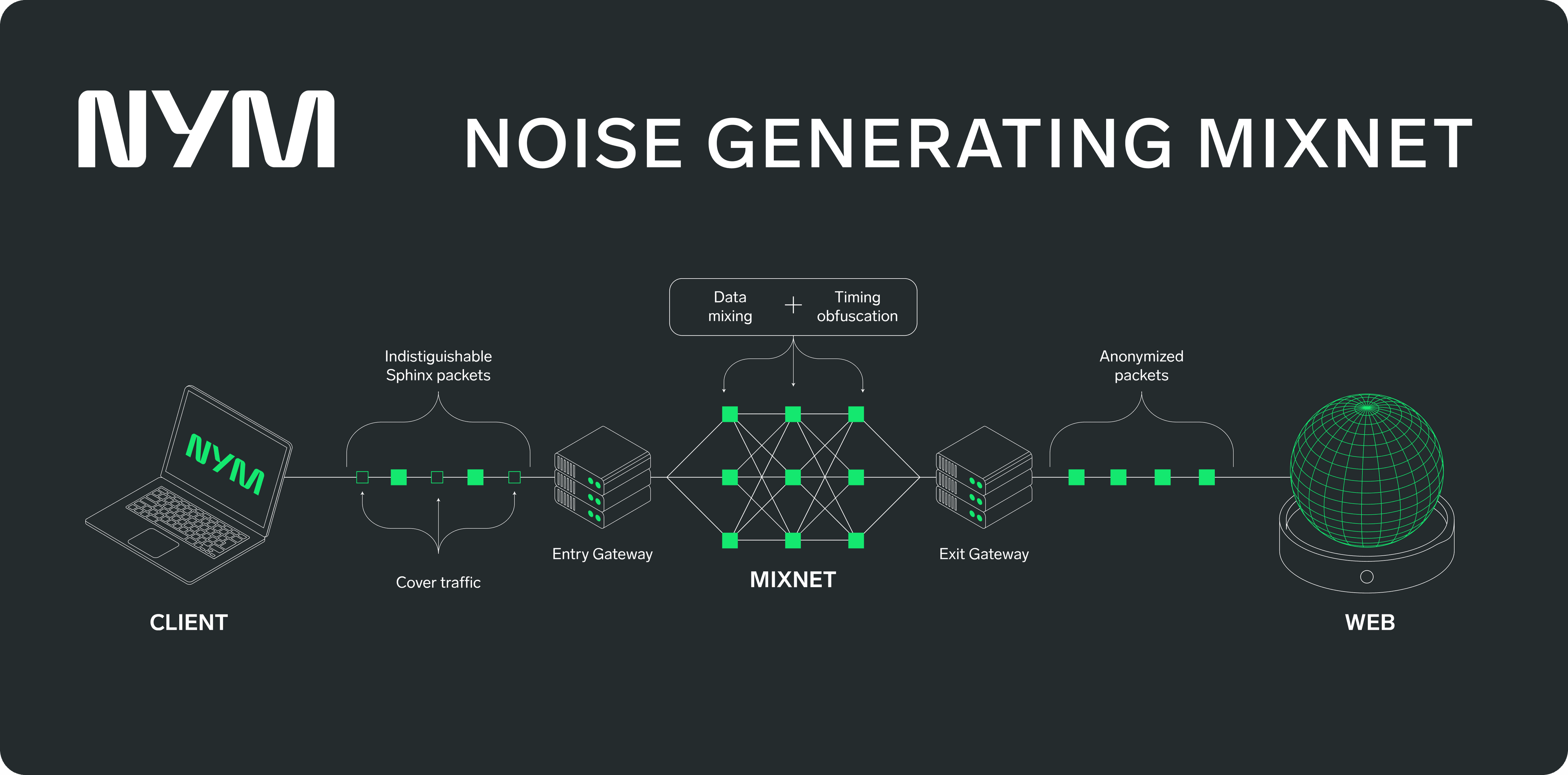
NymVPN's Anonymous mode routes traffic through a 5-hop Noise Generating Mixnet: an entry gateway, three intermediary mix nodes that shuffle and reorder encrypted packets, and an exit gateway. Cover traffic is added to mask timing patterns. This topology ensures no single node can link a user to their traffic, and even AI would have an extremely difficult job in reconstructing your route with certainty.
Mixnet (or mix network) defined: A privacy network where encrypted packets are shuffled across multiple nodes, with cover traffic added to defeat traffic analysis. Unlike simple multi-hop routing, mixnets reorder packets and introduce timing delays that make traffic patterns computationally infeasible to reconstruct.
Not just privacy, but speed
For users who prioritize speed, NymVPN's Fast mode provides 2-hop decentralized routing via AmneziaWG, a fork of the WireGuard protocol. This is significantly more private than any traditional VPN, with connection performance close to standard.
So, do you need a dVPN?
Traditional VPNs shift the privacy problem without solving it. Instead of trusting your ISP, you trust a company. For journalists, activists, and anyone living under surveillance – people for whom privacy is not a preference but a necessity – that distinction matters enormously.
Decentralized VPNs remove the central point of trust by design. NymVPN adds metadata protection that no traditional VPN or standard dVPN can match. It’s built not just for adversaries that are already collecting, but for a private internet to come.