

将来を見据えたプライバシー保護:ポスト量子セキュリティに向けたNymのロードマップ
これからの世界に必要な、人々のための強力な暗号技術の構築
共有
Nymでは、真のプライバシーとは単に「今日機能するもの」にとどまらず、未来を見据えることにあると常に信じてまいりました。セキュリティやプライバシーに対する脅威は絶えず変化しており、Nymもまた、その変化に遅れをとることなく対応し続けています。
暗号技術の情勢が変化する中、私たちはNymネットワークとNymVPNが将来にわたって機能し続けるよう対策を講じており、ユーザーが現在だけでなく、今後何年にもわたって保護され続けることを保証しています。そのため、私たちはすでに、NymネットワークとNymVPNの両方にポスト量子セキュリティを導入するための基盤整備を進めています。
What is post-quantum cryptography?
Quantum computing
Quantum computers are a new kind of computer that harnesses the principles of quantum mechanics to solve certain problems much more efficiently than classical computers. Although they are still in their early stages, with limited scale and capabilities today, they have the potential to break the mathematical assumptions underlying many existing cryptographic systems. 特に、量子コンピューティングは、ほとんどの現代の暗号技術の基盤となっている大きな数を因数分解できるようになると予想されています!
ポスト量子暗号技術
Post-quantum cryptography (PQC) refers to a new generation of cryptographic algorithms designed to remain secure against both conventional and quantum computers. PQC does this by changing the fundamental mathematical assumptions to ones where quantum computers do not seem to have any advantage over modern computers. While the cryptographic building blocks widely used today — such as key exchange protocols and digital signatures — are effective against classical computers, they would be vulnerable to quantum attacks in the future unless the underlying algorithm is changed.
PQC introduces alternatives that are resilient to both classical and quantum adversaries. Importantly, these new algorithms are designed to run on today’s hardware, making early adoption both feasible and practical.
The shift to post-quantum cryptography starts now
Every generation of cryptography eventually faces the same reality: what was once considered secure begins to show cracks. While quantum computers are still developing, the need to modernize cryptography is essential for long-term security. Thankfully, the resources to do so are already here.
The post-quantum data crisis
One of the more pressing reasons to start planning today for a post-quantum world is the long-term sensitivity of encrypted data. Even if large-scale quantum computers capable of breaking current cryptographic schemes don’t yet exist, adversaries can already collect and store encrypted communications with the goal of decrypting them in the future. この戦略は、しばしば 「今すぐ収集し、後で復号する(harvest now, decrypt later)」 と呼ばれています。多くの政府(そしてますます多くの民間企業)が、インターネット上で送信されるほぼすべての暗号化パケットを記録できることは周知の事実であり、まさにこの脅威に対抗するために、Nymは ノイズ生成ミックスネット(Noise Generating Mixnet) (NGM)を構築しました。
Yet the danger is that a powerful adversary like the NSA — even if they do not have a quantum computer today — will eventually get one. This will allow them to decrypt the massive amount of encrypted messages they have been recording for years. For individuals and organizations handling data that needs to remain private for years or decades, adopting post-quantum protections early is not just forward-thinking — it’s a vital necessity.
Preparing for post-quantum encryption
The shift toward modern cryptography isn’t just theoretical — it’s already underway. In 2024, the U.S. 米国国立標準技術研究所(NIST)は、RSAや**楕円曲線暗号(ECC)**など、広く使用されている暗号アルゴリズムを段階的に廃止するための【正式なスケジュール】(https://nvlpubs.nist.gov/nistpubs/ir/2024/NIST.IR.8547.ipd.pdf)を設定しました。 These algorithms are scheduled to be deprecated over the next several years, with a complete transition required by 2035 — a major milestone in the evolution of digital security standards.
In parallel, the standardization of post-quantum cryptographic algorithms is actively underway. 鍵確立のための**CRYSTALS-Kyber (ML-KEM)や、デジタル署名用のCRYSTALS-Dilithium (ML-KEM)、FALCON、SPHINCS+ (SLH-DSA)**など——は、すでに標準化の対象として選定されています。 Others are still under evaluation in ongoing rounds. This marks a significant step toward ensuring cryptographic resilience in the face of both current and emerging technological capabilities.
Nym’s approach to post-quantum security
At Nym, we’re taking a careful and forward-looking approach to integrating post-quantum cryptography across the entire ecosystem — from internal node communications to end-user connections and core protocol layers. 当社は、プライバシー、パフォーマンス、長期的な強靭性のバランスを取りながら、この移行を確実に成功させるため、ポスト量子暗号分野の第一人者たちと積極的に協力しています。
Rather than rushing to implement the latest cryptographic trend, we’re building a solid foundation for future-proof privacy. Our roadmap toward post-quantum security begins with establishing modern secure communication channels and then incrementally layering in quantum-resistant key exchange at every level of the Nym architecture. When selecting post-quantum algorithms, we are carefully evaluating a range of well-studied options, including those standardized by NIST. Our goal is to adopt robust and thoroughly analyzed schemes, and where appropriate, to use hybrid approaches. This ensures that the security of our system does not rely on the strength of a single cryptographic primitive alone.
Nym’s roadmap for post-quantum protections
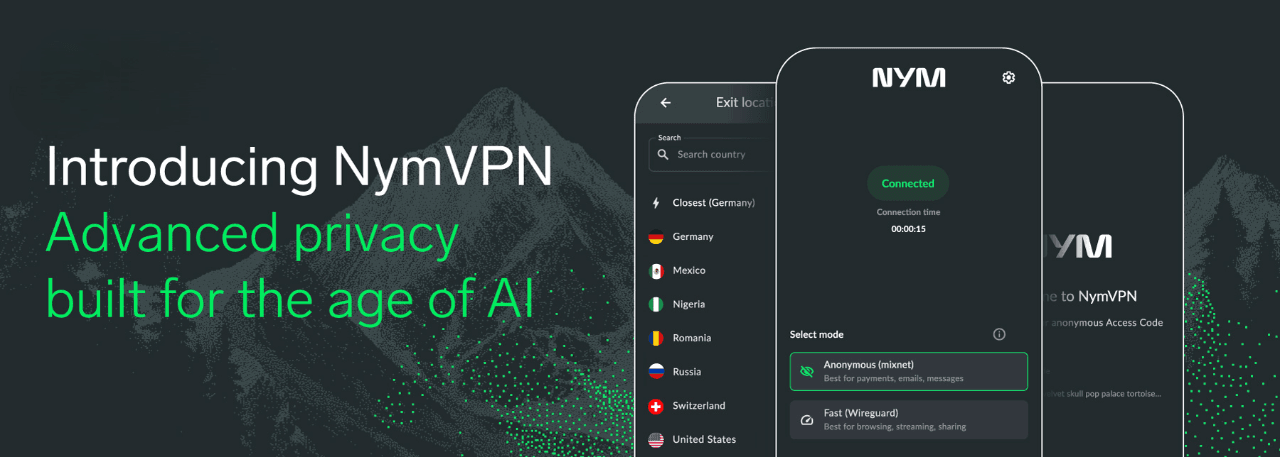
With NymVPN, you have a choice between two modes: a 2-hop Fast Mode and the 5-hop Anonymous Mode using the Noise Generating Mixnet. どちらも、堅牢で最新の暗号プリミティブに依存しています。 In the Fast Mode, client traffic is protected using the AmneziaWG protocol which ensures efficient, authenticated encryption and secure communication between the user and the exit gateway. In Anonymous Mode, traffic is encapsulated using the Sphinx cryptographic packet format to provide strong metadata protection.
Nym's Noise Generating Mixnet
Underlying these protocols are cryptographic key exchange mechanisms which are critical for establishing secure, forward-secret communication. That’s why one of our major goals this year is to introduce post-quantum secure key exchange across the Nym stack, ensuring long-term resilience against both classical and quantum adversaries.
Post-quantum security for the Nym network
Building on the foundation of the Noise Protocol, we plan to integrate a post-quantum secure key exchange into the Noise-based communication channels between mix nodes. This will ensure that messages relayed through the network benefit from forward secrecy and remain resilient against both classical and quantum adversaries. It’s a crucial step toward ensuring that the Nym network continues to provide strong privacy guarantees in the years to come.
Post-quantum protection for clients
Next, we will extend post-quantum protection to user connections. This means upgrading the communication between clients (or applications) and the entry nodes of the Nym network with post-quantum secure key exchange. By doing so, Nym will ensure that your traffic is protected with quantum-resistant encryption from the very first hop, from your device all the way into the network.
Post-quantum key exchange within the Sphinx packet format
Finally, we will enhance the Sphinx packet format which Nym uses to provide metadata-private message routing, with post-quantum secure key exchange. This will strengthen the cryptographic core of the NGM, ensuring that message encapsulation and routing remain resistant to future cryptanalytic advances, including those enabled by quantum computing.
Conclusion
Our commitment is clear: privacy isn’t something you should have to opt into — it should be built to last. Our mission at Nym is to make privacy accessible and resilient — to ensure advanced cryptographic protections aren’t a privilege, but a right.
We’re not just watching the standards develop — we’re actively preparing for a future where post-quantum security is the new normal. By laying the groundwork today, we’re building a future where post-quantum security is not an afterthought, but the standard that underpins real, lasting privacy.
Post-quantum cryptography: FAQs
NymVPN plans to adopt post‑quantum standards like CRYSTALS‑Kyber for key exchange at all protocol layers—ensuring forward secrecy even in a future quantum threat landscape.
Nym expects to fully integrate PQC by around 2025–2026, complementing NIST’s timeline which recommends deprecating ECC/RSA by 2035.
Yes—AmneziaWG in Fast Mode will be upgraded with PQC key exchange, protecting both client‑exit and gateway channels against future quantum attacks.
The Noise-based protocol between mixnodes will be enhanced with post‑quantum KEMs in order to secure internal routing metadata even under quantum-capable adversaries.
Nym employs hybrid handshakes (PQC + classical algorithms) to maintain compatibility during the transition, balancing performance with long-term quantum resilience.
About the authors

Ania M. Piotrowska, PhD