Generating and using zk-nym anonymous credentials
zk-nyms are already used in production by NymVPN to unlink subscription payments from network activity. The entire credential lifecycle described on this page (key generation, issuance, spending) happens inside the NymVPN application without user involvement. SDK integrations currently connect to the Mixnet without requiring credentials.
Generation of zk-nyms involves the following actors / pieces of infrastructure:
- Requester needing a zk-nym for example a single user using the NymVPN app, or a company purchasing zk-nyms to distribute to their app users, in the instance of an app integrating a Mixnet client via one of the SDKs. The Requester is represented by a Bech32 address on the Nyx blockchain.
- NymAPI instances working together on signature generation and spent credential validation, referred to as the NymAPI Quorum. Members of the Quorum are a subset of the Nyx chain Validator set (other tasks they perform include a multisig used for triggering reward payouts to the Network Infrastructure Node Operators and maintaining the global Bloom Filter for double-spend protection).
- OrderAPI: an API creating crypto/fiat to
NYMswaps and then depositing the NYM tokens in a smart contract managed by the NymAPI Quorum for payment verification. Implementation details of the API will be released in the coming months.
Generation happens in 3 distinct stages:
- Key Generation & payment
- Issue credential
- Generate unlinkable zk-nyms for Nym Network access
From the Requester’s perspective this happens without user involvement, producing an unlinkable, rerandomisable anonymous proof-of-payment credential (a zk-nym) that grants Mixnet access without linking usage to payment information. A single credential can be split into multiple smaller zk-nyms, so a Requester purchases bandwidth in bulk and spends it incrementally across different ingress Gateways as needed.
Key Generation & Payment
-
First, a Cosmos Bech32 address is created for the Requester. This is used to identify themselves when interacting with the OrderAPI via signed authentication tokens. This is the only identity the OrderAPI sees, and it cannot link this to the zk-nyms that will be generated. This identity never leaves the Requester’s device and there is no email or personal details needed for signup. If a Requester is ‘topping up’ their subscription, the creation of the address is skipped as it already exists.
-
The Requester also generates an ed25519 keypair: this is used to identify and authenticate them in the case of using zk-nyms across several devices as an individual user. However, this is never used in the clear: these keys are used as private attribute values within generated credentials which are verified via zero-knowledge and not publicly exposed.
-
The Requester can then interact with payment backends to pay for their zk-nyms with crypto, fiat options, or natively with NYM tokens.
-
Payment options will trigger the OrderAPI. This will:
- Create a swap for
<PAYMENT_AMOUNT>toNYMtokens. - Deposit these tokens with the NymAPI Quorum via a CosmWasm smart contract deployed on the Nyx blockchain.
- Create a swap for
-
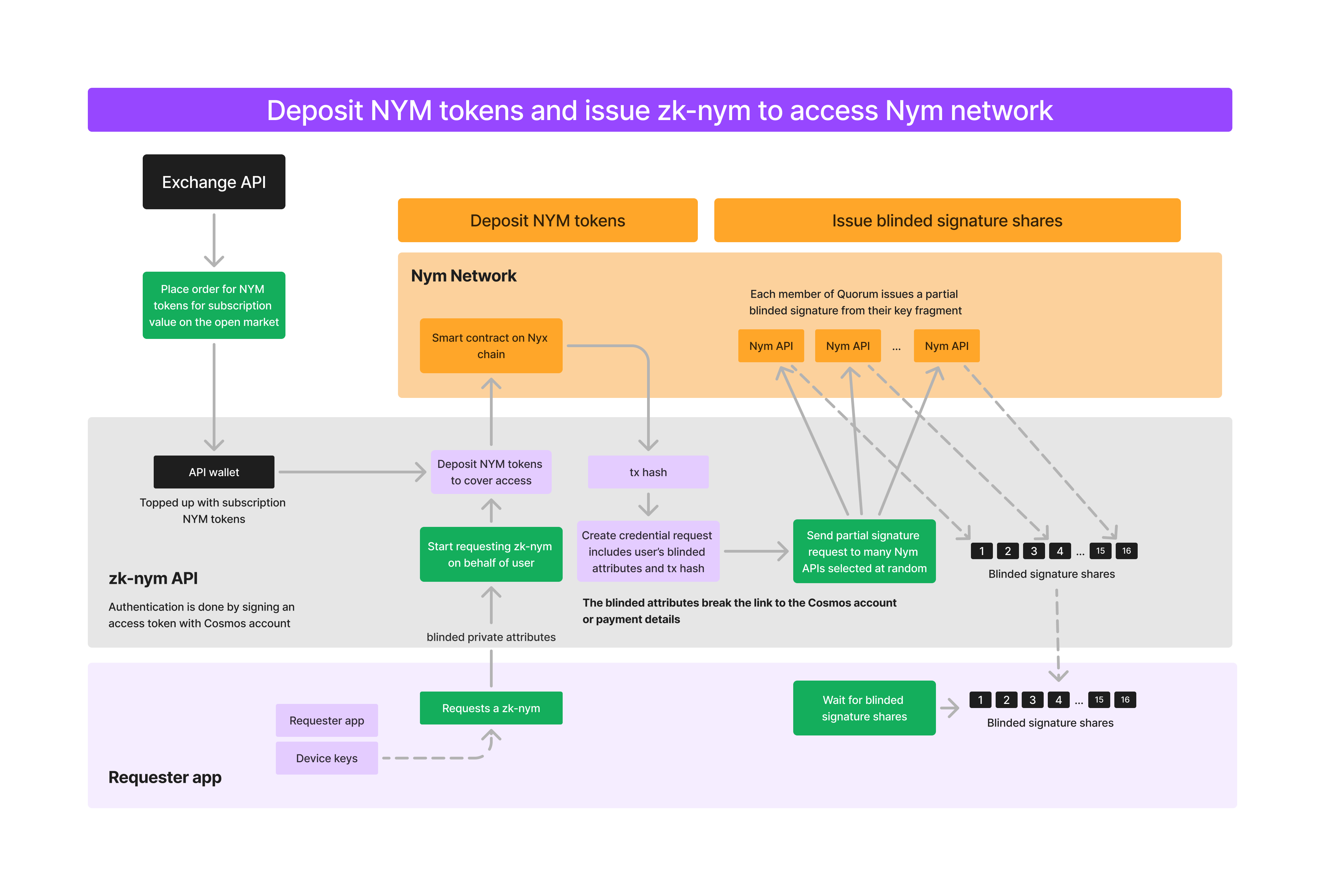
The Requester sends a request to each member of the Quorum requesting a zk-nym credential. This request is signed with their private key and includes the transaction hash of the NYM deposit into the deposit contract, performed either by themselves or the OrderAPI.
Issue zk-nym
At this point, NYM tokens have been deposited into the smart contract controlled by the Quorum’s multisig and a zk-nym has been requested. Next, each member of the Quorum who responds to the Requester’s request for a zk-nym checks the validity and returns a partial blinded signature - a ‘partial signed credential’ (‘PSC’) - signed with part of the master key (since this is a threshold cryptosystem, not all members of the Quorum must respond to create a zk-nym, only enough to pass the threshold). The process looks like this:
- Members of the Quorum perform several checks to verify the request is valid:
- They verify the signature sent as part of the request is valid and that the request was made in the last 48 hours.
- They verify that the amount requested matches the amount deposited in the transaction, the hash of which was signed by the Requester’s ed25519 key and sent as part of the request.
- Members then create a PSC from their fragment of the master key generated and split amongst them at the beginning of the Quorum in the initial DKG ceremony.
- The member also creates a
key:valueentry in their local cache with the transaction hash as the key, and the PSC + encrypted signature as the value. This is used later for zk-nym validation and is cleaned after a predefined timeout.
- The member also creates a
- These PSCs are given back to the Requester after setting up a secure channel via DH key exchange, with each replying Quorum member also sending their public key for verification that the returned PSC was signed by them.
Once the Requester has received over the threshold number of PSCs they can assemble them into a ‘ticketbook’ of ‘tickets’ - spendable credentials - signed by the master key. The Requester never learns this master key (it is a private attribute) but the credential can be verified by the Quorum as being valid by checking for a proof that the credential’s private attribute - the value of the master key - is valid.
Spend zk-nym to Access Mixnet
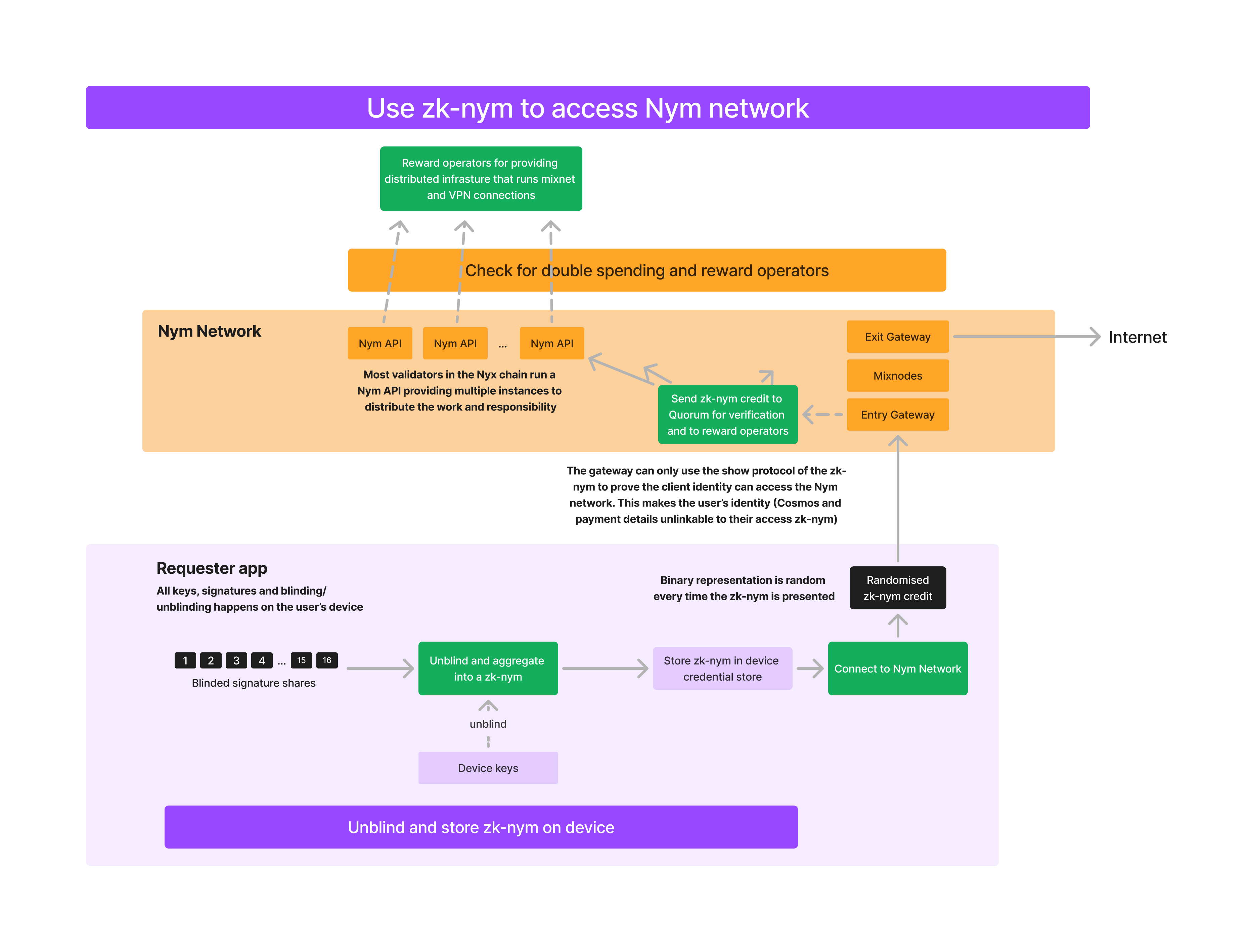
- Once the ticketbook has been aggregated from the PSCs returned from > threshold of Quorum members, smaller ‘ticket’ credentials can be generated from it, accounting for smaller chunks of bandwidth which can be ‘spent’ with ingress Gateways. This occurs entirely offline, on the device of the zk-nym Requester. See pages on the scheme’s unlinkability and rerandomisation and incremental spending features for further information on this.
- This ticket is later presented to the Quorum by the Gateway that collected it, which is used to calculate reward percentages given to Nym Network infrastructure operators by the Quorum, with payouts triggered by their multisig wallet. Both ingress Gateways and the Quorum use spent tickets when engaging in double spending protection.