The surge in VPN use in India
India's digital uprising is no longer voluntary: it's a question of survival. Interest in Virtual Private Networks (VPNs) surged 72% in India during blocking campaigns this year. [13] We are on the brink of seeing India's billion dollar VPN market switching from optional privacy tools to essential digital infrastructure. [5] This isn’t just voluntary adoption: it’s a forced digital resistance.
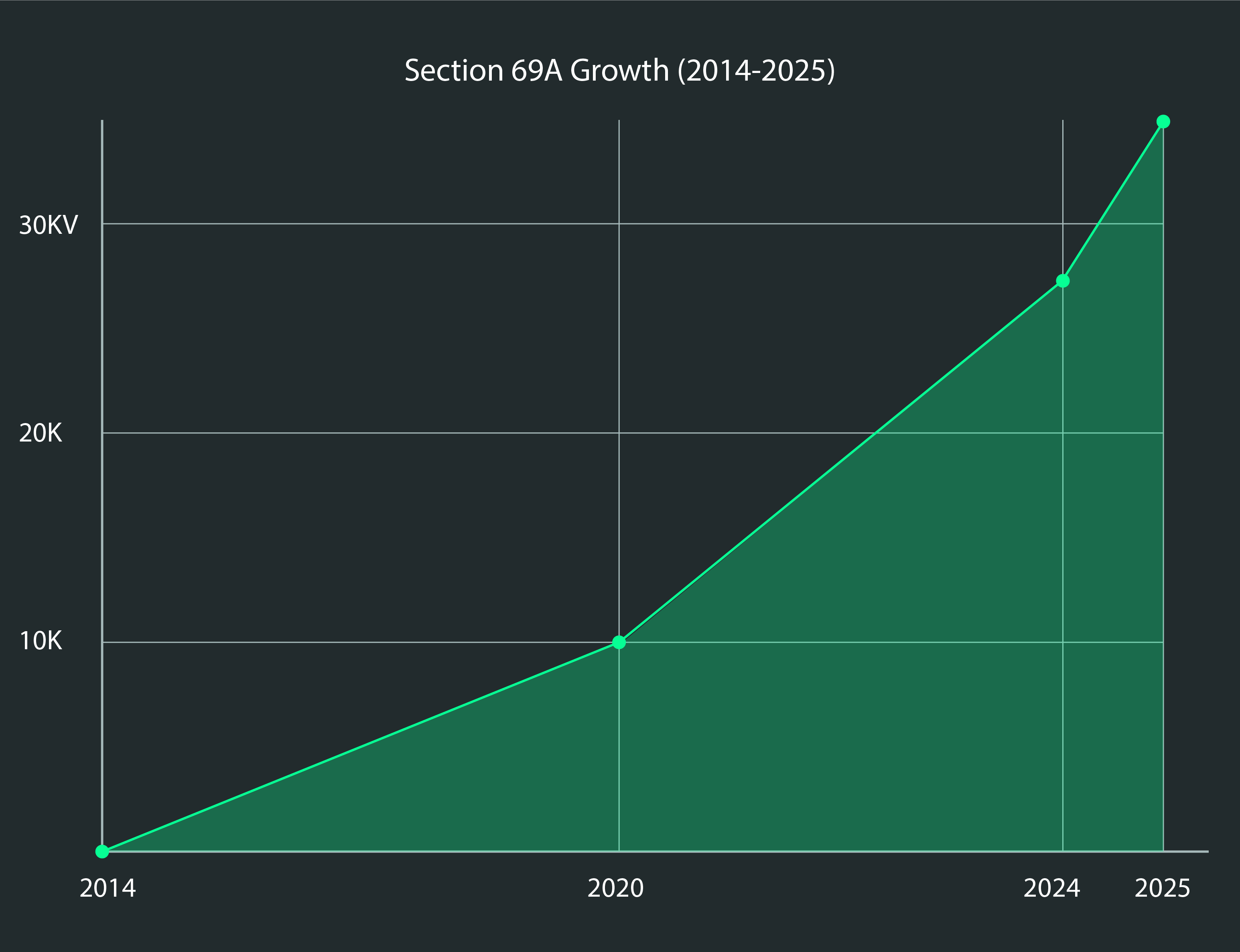
In 2024 alone, authorities blocked over 28,000 URLs under Section 69A while imposing 84 internet shutdowns, the highest globally among democracies. [4] [7] But this is about the control of information as well as people: in recent years we have also seen arrests for VPN use in the states of Jammu and Kashmir. [11]
The government’s actions, including the expansion of censorship tools like the SAHYOG portal, have prompted the widespread adoption of privacy technologies as a means to restore access to information. [2] As India navigates this tension between security and digital rights, the role of VPNs has evolved from a technical workaround to a critical component of digital resilience.
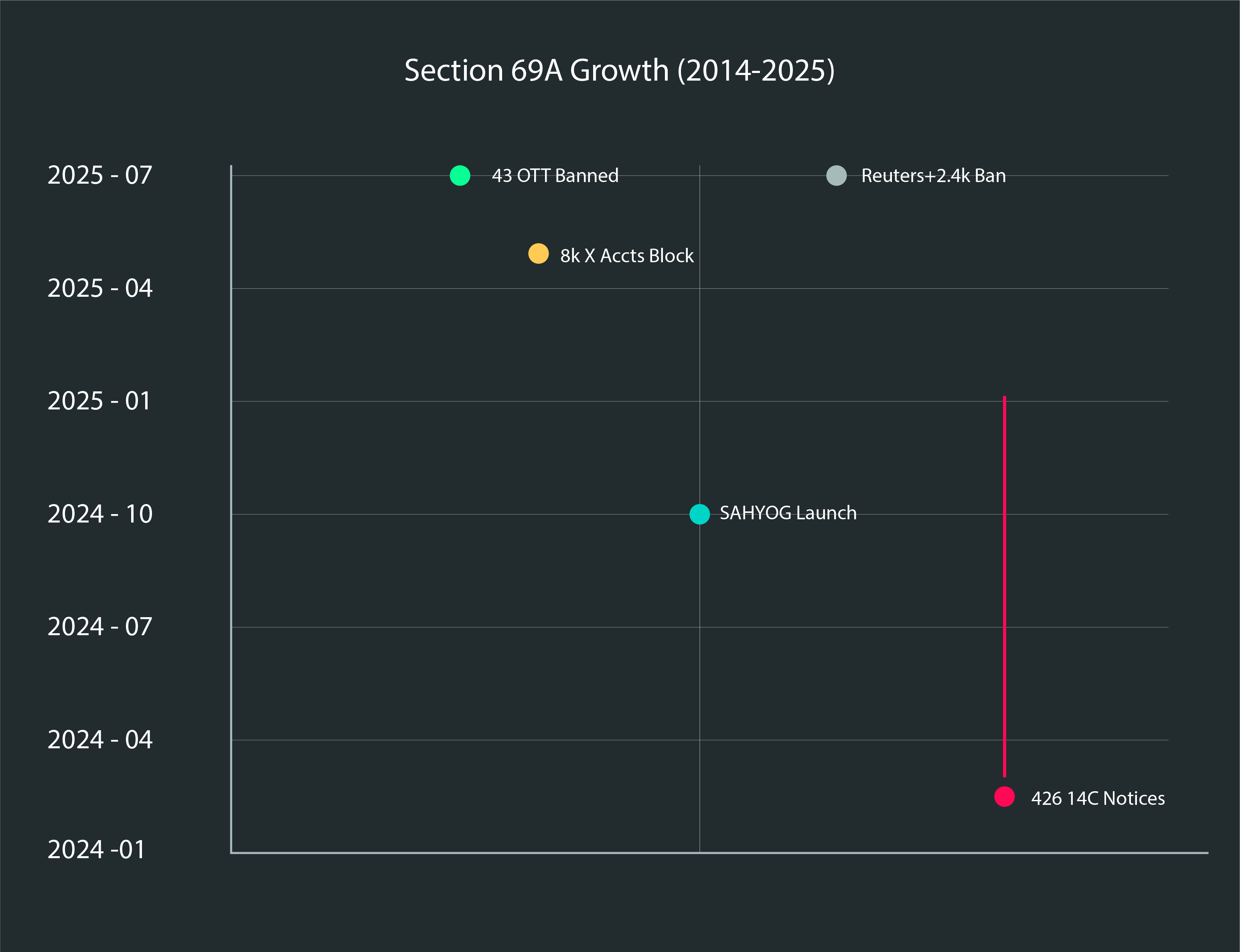
Exponential increase in censorship orders from 2014–2024
India's digital panopticon: Section 69A and SAHYOG
The cornerstone of India's censorship regime is Section 69A of the Information Technology Act (2000). This law grants the government sweeping powers to block any online information deemed to be a threat to national “sovereignty, integrity, security, or public order.” [1]
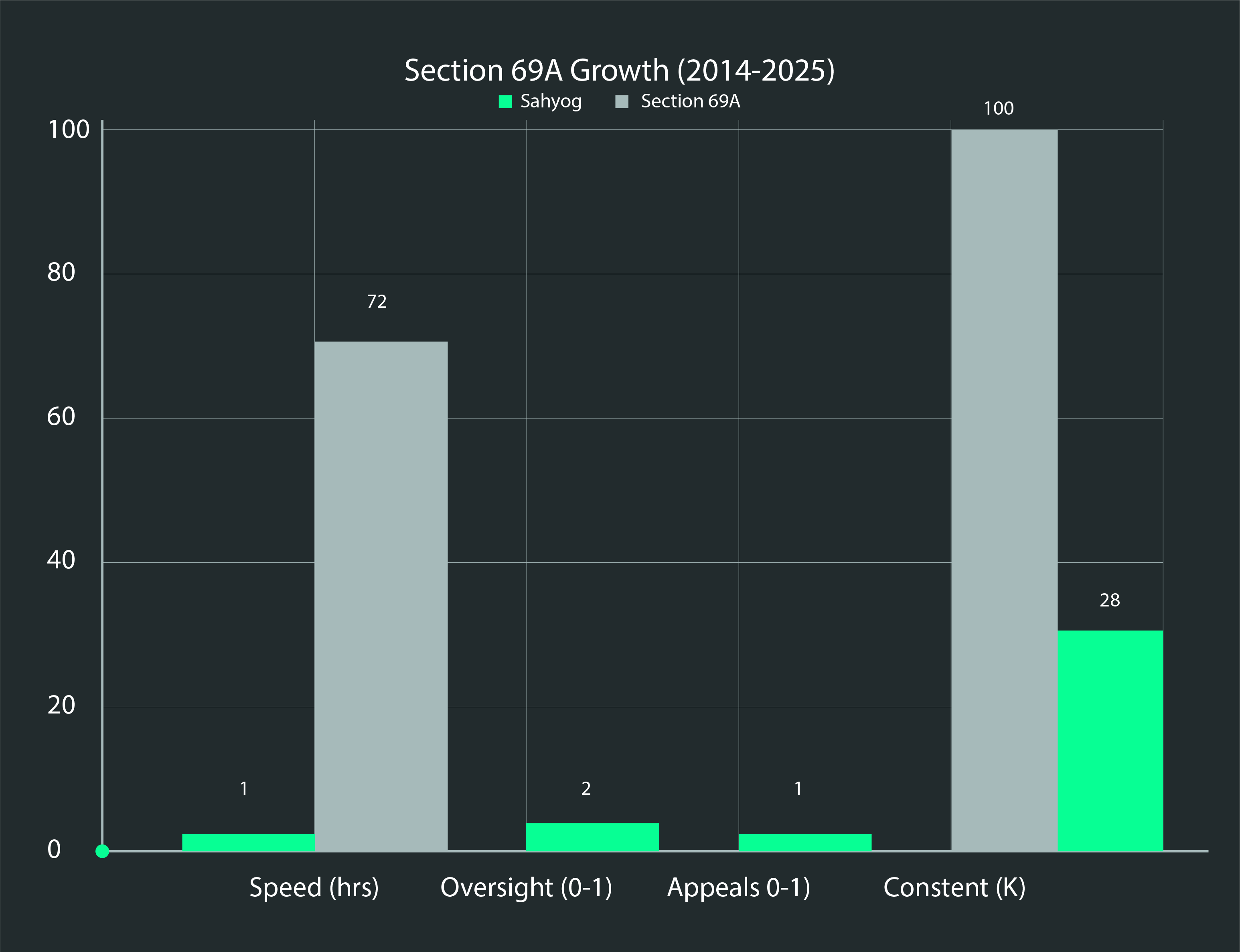
Comparison showing SAHYOG’s rapid and minimally supervised censorship enabling near real-time takedowns, versus Section 69A’s slower process with limited oversight
In practice, Section 69A is a legal black box. The law's broad, subjective grounds allow virtually any inconvenient content – from legitimate news to satire – to be censored. Orders are issued in secret and without public justification. Intermediaries (such as ISPs and social media platforms) are ordered to comply within hours under threat of criminal liability. This is creating a digital panopticon where the mere possibility of erasure chills free expression.
The SAHYOG portal is essentially a "backdoor censorship engine" which makes Section 69A seem restrained. Launched in October 2024 by the Ministry of Home Affairs, the SAHYOG portal is a centralized, automated system that facilitates content removal requests between government bodies and internet intermediaries in India. [2]
The portal dangerously spreads censorship power. It allows any authorized agency – from federal ministries down to district police – to issue demands for the removal of content, effectively bypassing Section 69A's minimal safeguards. There is no committee review, no reasoned order, and no appeals mechanism. In its first nine months, SAHYOG generated 294 orders covering approximately 3,300 URLs.
X (formerly Twitter), which refused to comply, is currently suing the Indian government, accusing SAHYOG of being a “censorship portal” that vests “blanket and unguided power” in anonymous officials. [2] Court filings show that over 70% of removal requests to X now flow through this unaccountable system.
The censorship machine in action: India’s industrial censorship infrastructure
India’s internet censorship employs layered technical and legal tactics for efficient control. As documented by Open Observatory of Network Interference (OONI), ISPs implement DNS filtering and IP blacklisting, often inconsistently across networks. [8] For example, a site may be blocked on one carrier but accessible on another. Platforms receive “one-hour emergency” orders, risking their revocation as internet services if non-compliant and exposing them to user-content liability.
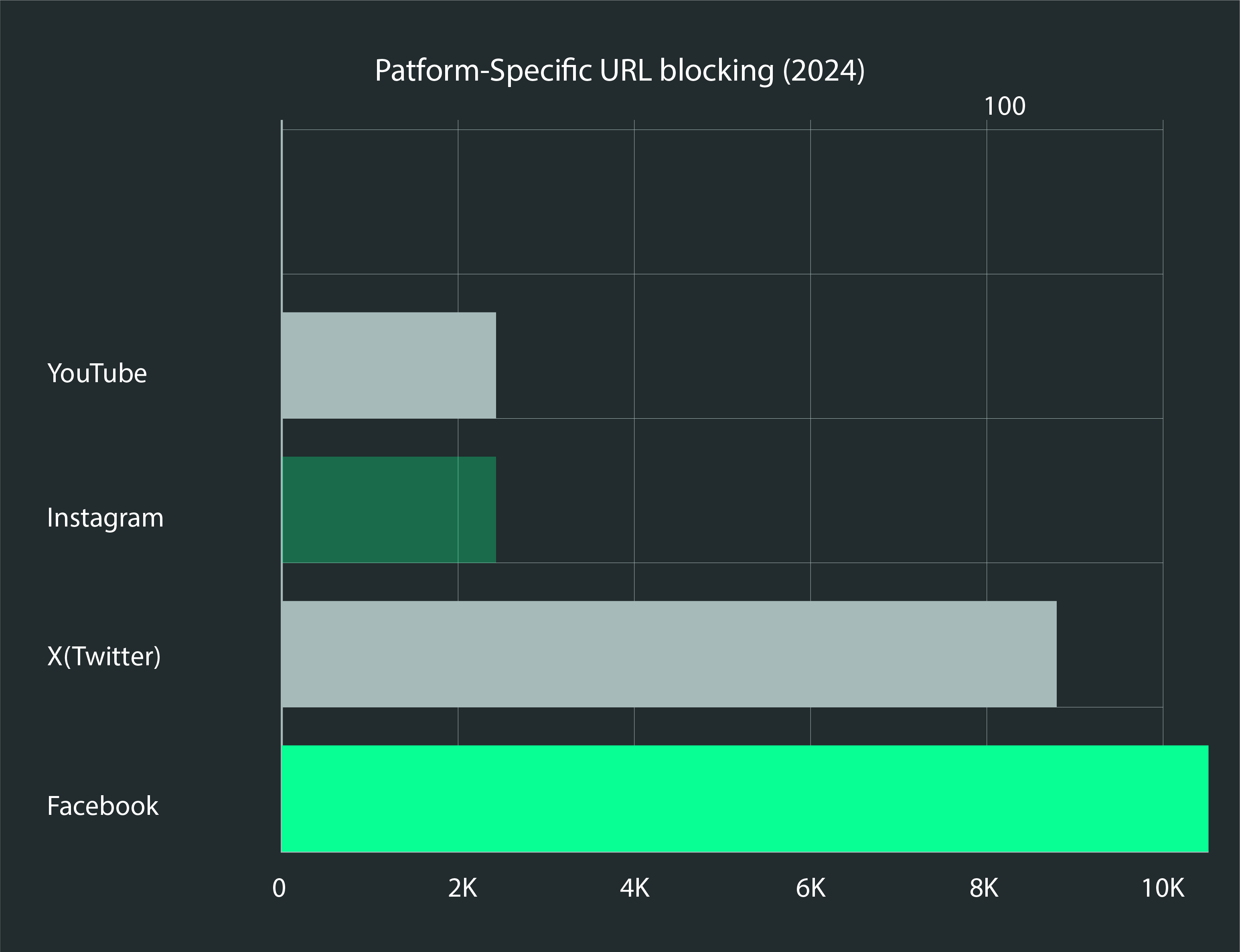
The machinery’s scale is siginificant. In 2024, over 28,000 URLs were blocked, including 10,500 related to the Farmers Protest which began in 2021, and 2,100 tied to the Popular Front of India, a social justice party. [4] During the Indo-Pakistani tensions following the Pahalgam attack in May 2025, OONI confirmed that 12 news sites were blocked, while over 8,000 X accounts – including BBC Urdu and Pakistani outlets – were suspended for reasons of “national security.” [9] [8] This included Chinese state media outlets such as Global Times and Xinhua which were accused of spreading disinformation. [8]
Escalation peaked in July 2025 when the government ordered X to block 2,355 accounts under Section 69A, including Reuters’ @Reuters and @ReutersWorld handles. [9] X’s Global Affairs highlighted the demand for “immediate action within one hour” without any justification being provided to the platform. While accounts were restored after 24 hours amid diplomatic pressure, the incident underscored the vulnerabilities faced by platforms. Real victims included @MenchOsint (a military analyst) and @SouleFacts (a Assamese activist) whose accounts were geo-blocked without notice. However temporary, these types of sudden, irreversible actions create a digital void, isolating users from information during crises.
The technical implementation often involves deep packet inspection to detect and throttle traffic, adding layers of complexity for users attempting to circumvent restrictions. Reports indicate that such blocks disproportionately affect rural and low-income users reliant on mobile data, thus exacerbating digital divides between classes in Indian society.
Facebook and X face industrial-scale censorship with over 10,000 blocked URLs on each platform in 2024
India’s vanishing voices: What's being censored and why it matters
Targets of censorship reveal a pattern of narrative control. Political and conflict news, especially around Indo-Pakistani issues, have faced heavy restrictions: 12 sites were blocked in May 2025 alone. [8] Dissenting opinions and satire, like anti-government memes, are removed under the pretexts of preserving "public order.” Content labeled "obscene," such as on OTT platforms, triggers mass bans.
Examples abound: During Operation Sindoor in May 2025, BBC, Reuters, and Pakistani media were inaccessible. Independent and PFI posts comprise thousands of blocked URLs. [4] On 25 July 2025, 25 OTT platforms – including ULLU, ALTT, and Desiflix – were banned for "vulgar" content under the Indecent Representation of Women Act. [10] Academic sites like Sci-Hub are routinely swept up.
Official rationales cite “disinformation” and “order,” but critics argue it muzzles criticism during elections and conflicts. [14]. While official state rationales include safeguarding security, the opacity around these decisions erodes accountability.
Imagine a "censorship map": conflict news vanishes mid-crisis, online reporting disappears, entertainment halts on moral grounds. What if Google or Wikipedia were blocked during exams or polls? Public discourse erodes, fostering an uninformed populace vulnerable to manipulation. Student resources become collateral damage (e.g., lost access to lectures), NGOs have their reports erased, and businesses struggle with disrupted digital tools. Education, rights, and the economy are all undermined in the crosshairs of a digital information war. Innovation is stifled as researchers and entrepreneurs face barriers to global knowledge, and social tensions become inflamed from one-sided narratives.
India's VPN explosion: A silent grassroots rebellion
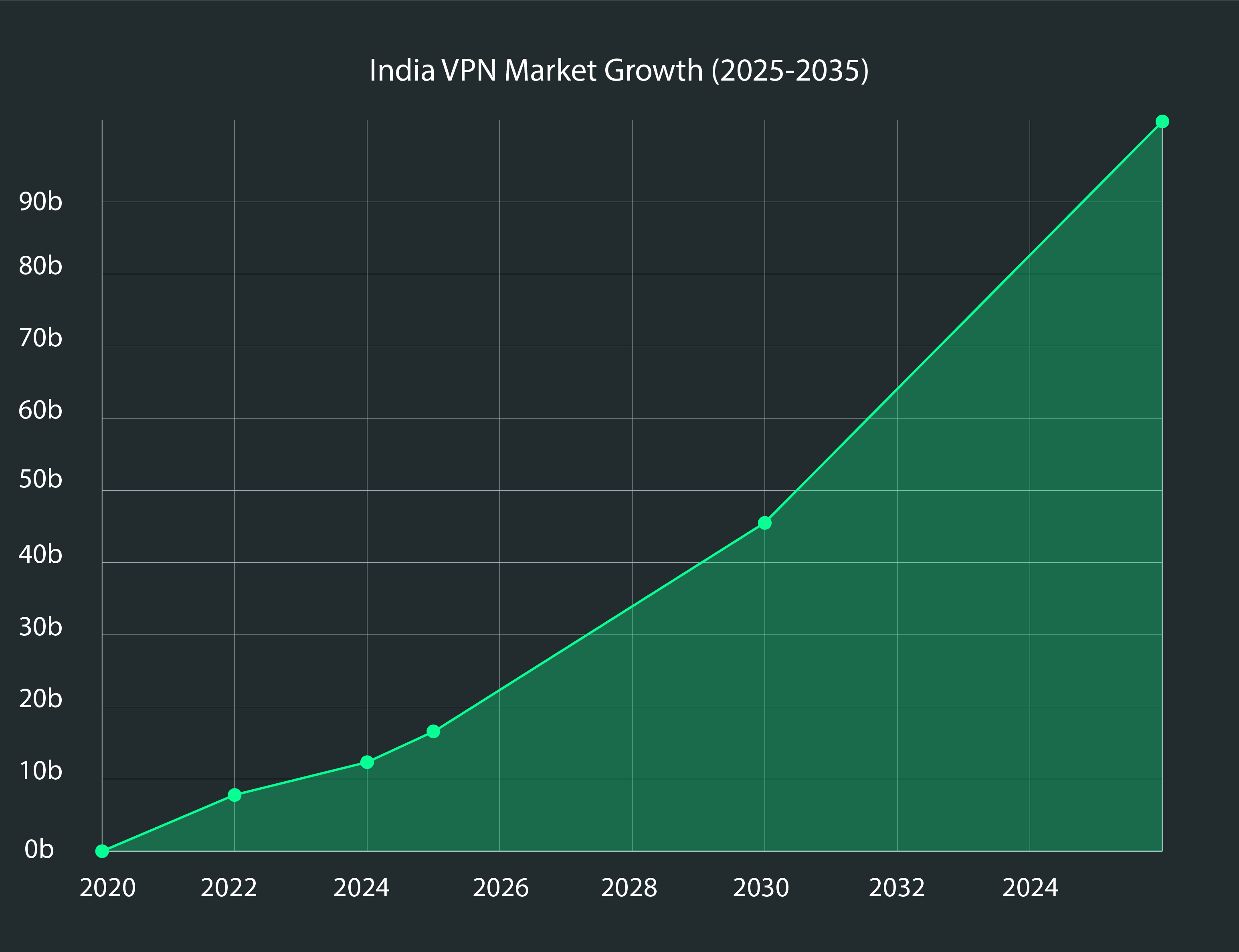
Market value projection showing exponential VPN growth from $2.5B to $89B by 2035
Censorship has nonetheless sparked a VPN boom in India: there are now 403 million users at a 27–32% penetration, making India a leading global market for privacy and anti-censorship tools. [3] [5] Driving this are basic human needs: to evade blocks, protect data under IT rules, and access censored content. The $11.6 billion market, growing at 20%–25% CAGR, shows that VPNs are effectively becoming "internet lifelines" for many in India. [12]
The state has aggressively countered this turn to VPNs. In May 2025, the Doda district (Jammu & Kashmir) imposed a two-month VPN ban under Section 163 BNSS for "security" reasons, leading to physical detentions of VPN users – the first localized criminalization of privacy tools in a democracy. [11] Over 50 users have since faced charges and had their devices seized.
India’s free VPN problem
While the exact numbers of India’s growing VPN market are still being estimated, one thing is clear from global VPN numbers: almost half of VPN users worldwide are using free VPNs. Given the economic resources of India’s large population compared to those in the West, this turn to free VPN apps is likely exacerbated in India. Unfortunately, this poses a huge privacy problem for people looking to VPNs to fight against surveillance and censorship.
The reality is that free VPN software is flawed by design. First, free VPN services are highly centralized, facilitating people’s traffic through single servers where their traffic patterns can be logged. Second, free VPNs have also been revealed to function as spyware or data harvesting tools. This data is compiled by VPN companies in order to be sold to third parties like data brokers, or potentially handed over to governments to track people’s activities across the web. Free VPNs leave people vulnerable to the very surveillance mechanisms they are looking to avoid.
This trend is inflamed by the fact, as has recently been revealed, that many ostensibly different VPN apps are actually owned and controlled by a small group of parent companies, many with links to the governments and intelligence agencies operating the world’s most advanced surveillance and censorship systems. [15] This is the opposite of privacy: it’s a wolf in sheep’s clothing.
Thankfully, real privacy with a VPN is possible thanks to decentralized technology.