

Is Zcash anonymous? Shielded and transparent transactions explained
Zcash can be one of the most private ways to hold crypto, or barely private at all. The difference is how you use it, and what the network can still see.

Share
Zcash is one of the best privacy coins, but what makes it actually anonymous? The honest answer is that it can be, but it isn't by default. Even at its most private, there is one layer Zcash was never designed to cover. This guide explains what Zcash hides, what it doesn't, and how to choose the Zcash route that's right for you.
The question is especially pressing right now. On 28 July 2026, Zcash's Ironwood upgrade forces every holder of shielded Orchard funds to migrate them into a new pool, and that migration is exactly the kind of moment where your on-chain privacy with Zcash can be compromised at the network layer. Whether you hold ZEC or are simply curious how private it really is, understanding what Zcash protects, and what it doesn't, matters more right now than usual.
Short answer: Zcash can be anonymous, but only if you use shielded addresses and protect your network layer. By default, and on transparent addresses, it is about as private as Bitcoin.
What is Zcash?
Zcash launched in 2016, built on Bitcoin's codebase with one major addition: zk-SNARKs, a form of zero-knowledge proof that lets the network verify a transaction is valid without revealing the sender, the receiver, or the amount. That is the cryptography behind Zcash's privacy.
The important thing to understand is that this privacy is optional. Unlike Monero, where every transaction is private by design, Zcash lets you choose. Some transactions are fully shielded; others are completely public. Whether you are anonymous depends entirely on which you use.
Shielded vs. transparent transactions
Zcash has two kinds of address, and the difference between them is the whole story.
A transparent address (it starts with a "t") works exactly like Bitcoin. The sender, the receiver, and the amount are all written to the public blockchain, where anyone can read them.
A shielded address (Sapling shielded addresses start with a "z"; newer Orchard funds use a unified address starting with a "u") uses zk-SNARKs to encrypt those details on-chain. The transaction is still verified by the network, but the sender, receiver, amount, and even an optional message are hidden.
| Transparent (t-address) | Shielded (z / unified address) | |
|---|---|---|
| Sender | Public | Hidden |
| Receiver | Public | Hidden |
| Amount | Public | Hidden |
| Message (memo) | Not supported | Encrypted |
| Behaves like | Bitcoin | Private by design |
The catch is that a lot of the surrounding infrastructure still defaults to transparent. Most exchanges list only transparent ZEC, and some hardware wallets (such as Ledger and Trezor) support transparent only, so a large share of ZEC activity is fully public. Dedicated Zcash wallets like Zodl increasingly shield by default, but using Zcash privately is still a deliberate choice, not something every tool does for you.
The four Zcash transaction types
Because there are two address types, a transaction can cross between them in four ways:
- Transparent to transparent (t→t): fully public, like Bitcoin.
- Shielding (t→z): moving public funds into the shielded pool.
- Shielded to shielded (z→z): fully private, the only genuinely anonymous option.
- Deshielding (z→t): moving shielded funds back out to a public address.
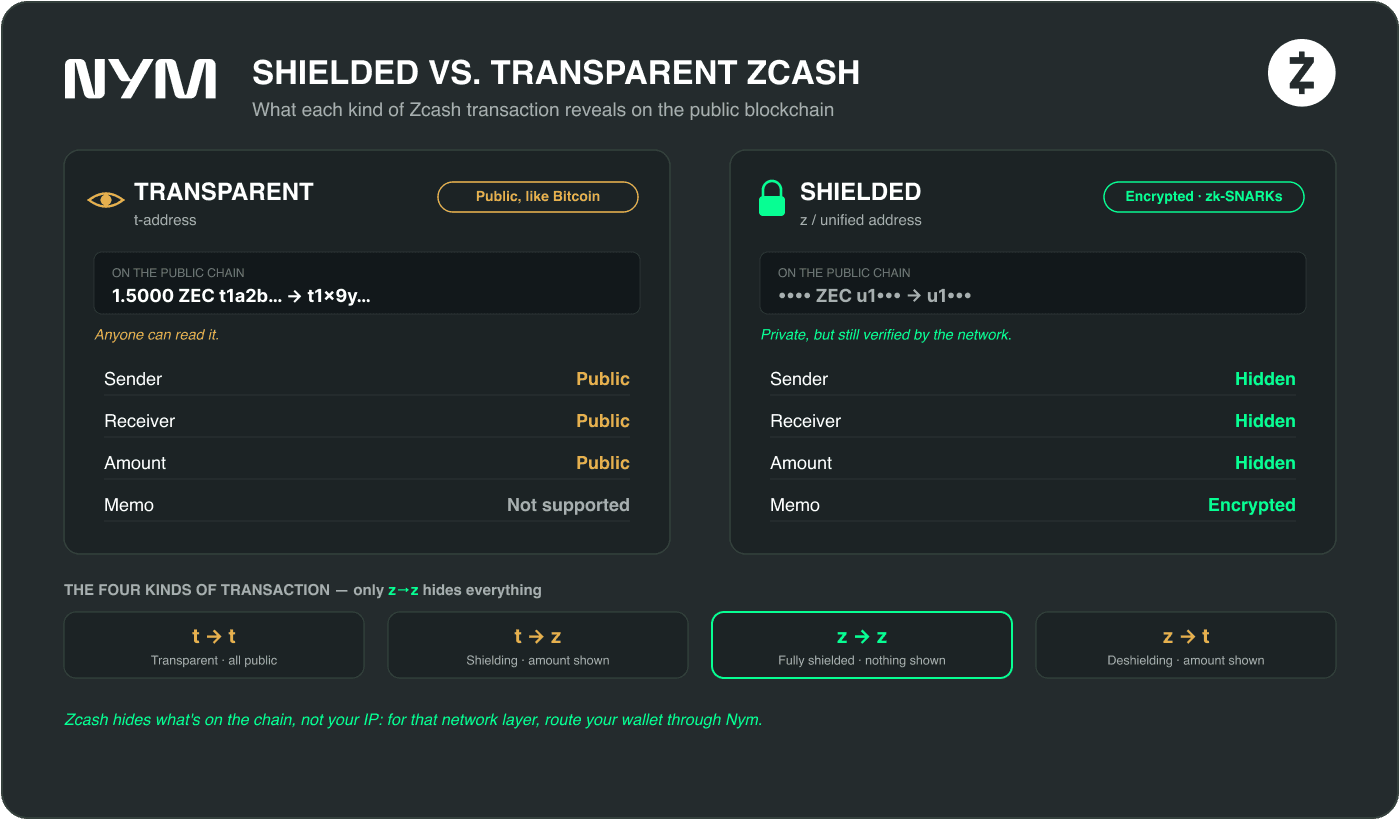
Only z→z hides everything. Every time value crosses the boundary between transparent and shielded, information leaks: the amount becomes visible, and the timing can be correlated with other activity. A payment that goes t→z→t is far easier to trace than one that stays shielded the whole way.
What Zcash hides, and what it doesn't
Used correctly, a shielded z→z transaction hides the sender, receiver, amount, and memo on the blockchain. That is genuinely strong privacy, and it is more than Bitcoin offers.
But on-chain privacy is not the same as anonymity. Even a perfectly shielded transaction can leak through layers Zcash's cryptography does not touch:
- The network layer. Zcash has no built-in network anonymity. When your wallet talks to a server to sync or broadcast, it reveals your IP address. That server, or anyone watching your connection, can link your identity to your activity even when the on-chain data is encrypted. This is a form of metadata leakage, and it is the privacy risk most users never think about.
- The transparency boundary. Shielding and deshielding reveal amounts and timing, which can be correlated with exchange withdrawals or other known events.
- The anonymity set. Shielded privacy works by hiding you in a crowd. The smaller the number of people using shielded transactions, the less cover there is.
- Exchanges and KYC. If you buy or sell ZEC on an exchange that holds your identity documents, that identity can be tied to the funds at the edges, no matter how private the chain is.
In short: Zcash's strongest privacy comes from using shielded addresses and protecting the network layer underneath them. One without the other leaves a door open.
A live example: the Ironwood upgrade
This gap is not theoretical. Zcash's Ironwood upgrade requires every holder to migrate their Orchard shielded funds, and that migration reveals the amount being moved and links it to the IP address that submits it. It is a real, large-scale illustration of the network-layer problem: strong on-chain privacy, undone at the network layer.
How NymVPN protects your network-level anonymity
Zcash's cryptography protects the blockchain. It does nothing about the network your wallet uses to reach it, and that is the layer where anonymity is most often lost. Every time your wallet syncs or broadcasts a transaction, it reveals your IP address to the server it talks to. That is where NymVPN comes in.
The type of VPN matters. Most VPNs hide your IP address from the wider internet, then hand it to a single company that can see both who you are and what you are doing. You have not removed the exposure: you've only moved it to a party you need to trust. Unfortunately, that VPN company can be compelled to hand the link over and deanonymize you.
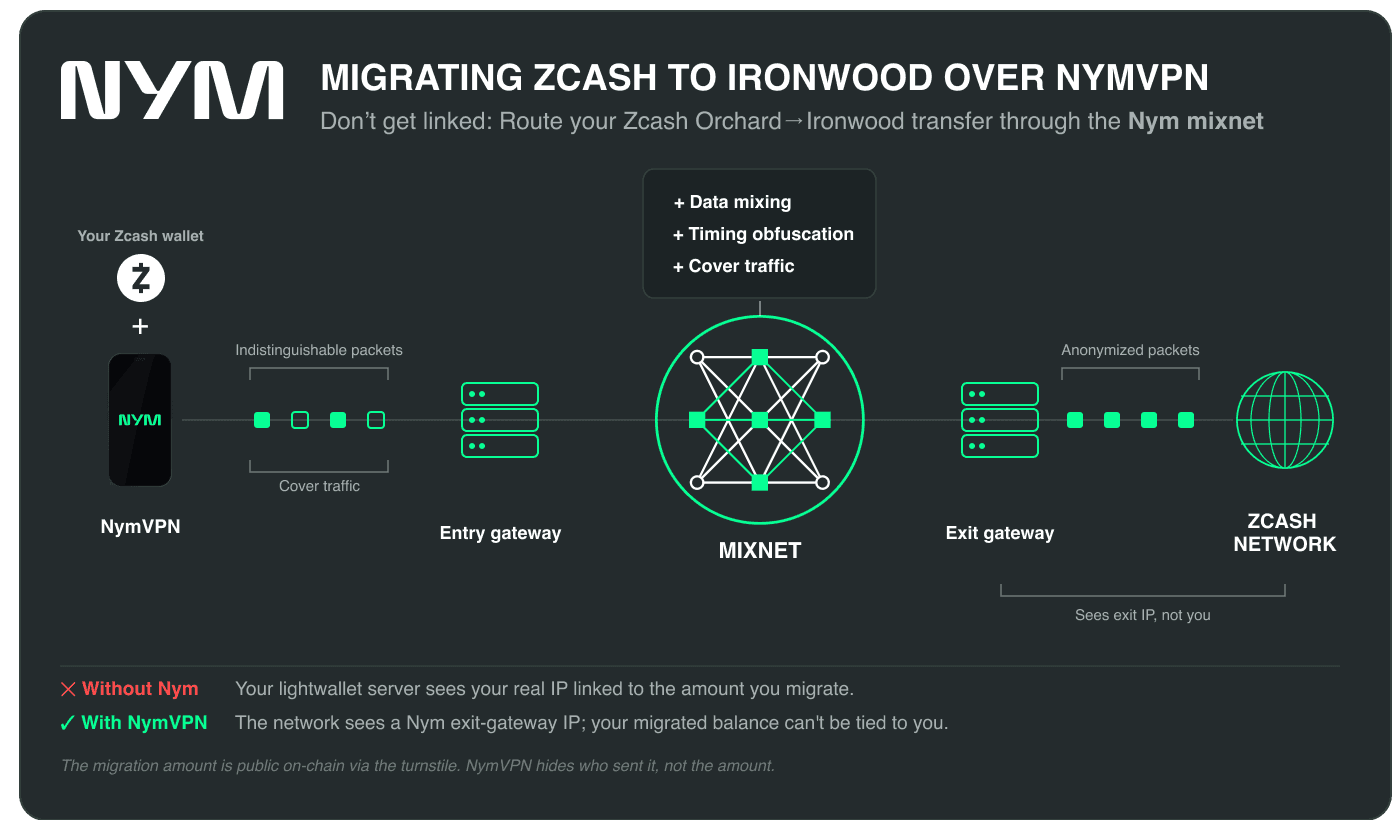
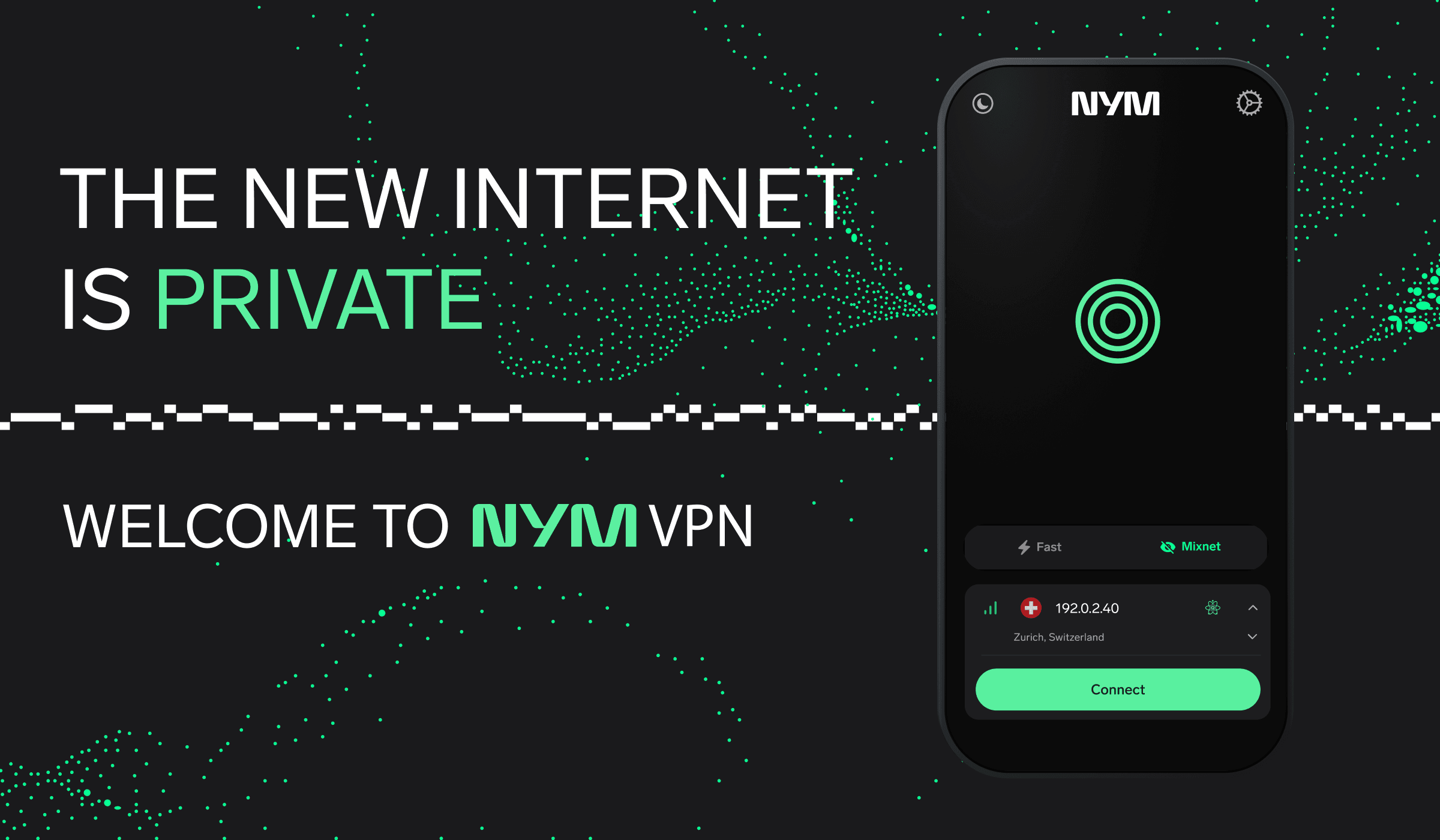
NymVPN is built different by design. It routes your traffic across a decentralized network of independent nodes so no single operator, Nym included, can tie your identity to your activity.
NymVPN offers two levels of protection: Fast mode, a decentralized VPN that hides your IP address, and Mixnet mode, which routes your traffic through the Noise Generating Mixnet with cover traffic to hide your traffic patterns as well. Paired with shielded transactions, it closes the loop: Zcash hides what happens on the chain, and Nym hides the person behind it on the network: you.
This matters most at moments of exposure like the Ironwood migration, where the amount you move becomes public and can be linked to your IP.
Is Zcash anonymous? Nym's verdict
Zcash gives you the tools for private crypto finance, but it does not make you anonymous automatically. Hold ZEC in transparent addresses and it is about as private as Bitcoin. Use shielded z→z transactions and protect your network layer with a tool like Nym, and it becomes one of the most private ways to move money online. The technology available is strong, but in the end privacy is a choice you make.
Zcash (ZEC) shielded vs. unshielded: FAQs
It depends on the wallet. Transparent addresses are fully public, like Bitcoin, and you only get Zcash's privacy with shielded addresses. Exchanges and some wallets still default to transparent, though dedicated Zcash wallets increasingly shield by default.
Transparent transactions are as traceable as Bitcoin. Fully shielded (z→z) transactions hide the sender, receiver, and amount on-chain, but network-level metadata like your IP can still deanonymize you if it isn't protected.
Only when you use shielded addresses. Transparent ZEC offers no more privacy than Bitcoin; shielded ZEC offers substantially more.
It can protect the network layer that Zcash doesn't. A regular VPN hides your IP but centralizes trust in one provider. A decentralized, mixnet-based option like NymVPN protects the network layer without a single party able to link your IP to your activity. You can read more about how Nym's zero-knowledge network works.
Keep funds in shielded addresses, transact shielded-to-shielded, and route your wallet's traffic through the Nym mixnet so your IP can't be tied to your balance.
About the authors
Casey Ford, PhD
Communications LeadTable of contents
Keep Reading...
$NYM on Edge: $NYM integrated on Edge Wallet
The self-custodial wallet built on privacy principles & a trusted partner in the Nym privacy stack
$NYM token is now live on Binance Smart Chain
Nym is now plugged in to the Binance ecosystem
NYM token flow: Powering the most private network
Delivering value to NymVPN users, operators, and builders
The Value of NYM: The spice powering our network
The real world value of the token behind NymVPN