Watch porn privately in the U.S.
Using a VPN can protect you from having to expose your personal information to age verification surveillance



Share
In 2025, a wave of state-level age verification laws is sweeping across the United States. From Utah to Texas, lawmakers are requiring adult sites to check a visitor’s government-issued ID before allowing access. The stated goal is protecting minors — but in reality, these systems create enormous databases that connect people’s real names and birthdays to their most intimate browsing history.
That’s not just invasive. In the wrong hands, it’s dangerous. Age verification is surveillance. Fortunately, there’s a way to keep your digital life out of those databases: using a VPN — ideally a [decentralized VPN like NymVPN.


What is a VPN?
How to watch porn privately in the U.S.
-
Install a trusted VPN app on your device.
-
Select a server in a state or country without porn restrictions.
-
Open your browser in private or incognito mode.
-
Run a quick IP leak test to ensure your real location isn’t exposed.
-
Avoid signing in with personal accounts when viewing adult content.
Disclaimer: Note that accessing pornography in certain locations may be illegal in your jurisdiction and could risk serious penalties. The information below is meant to inform you of where accessing porn is currently illegal and to make you aware of the possible repercussions. While Nym does not condone the use of its privacy services in violation of laws, we strongly believe that the access to global information in general should be a personal choice and should not be restricted by lawful or unlawful censorship measures.
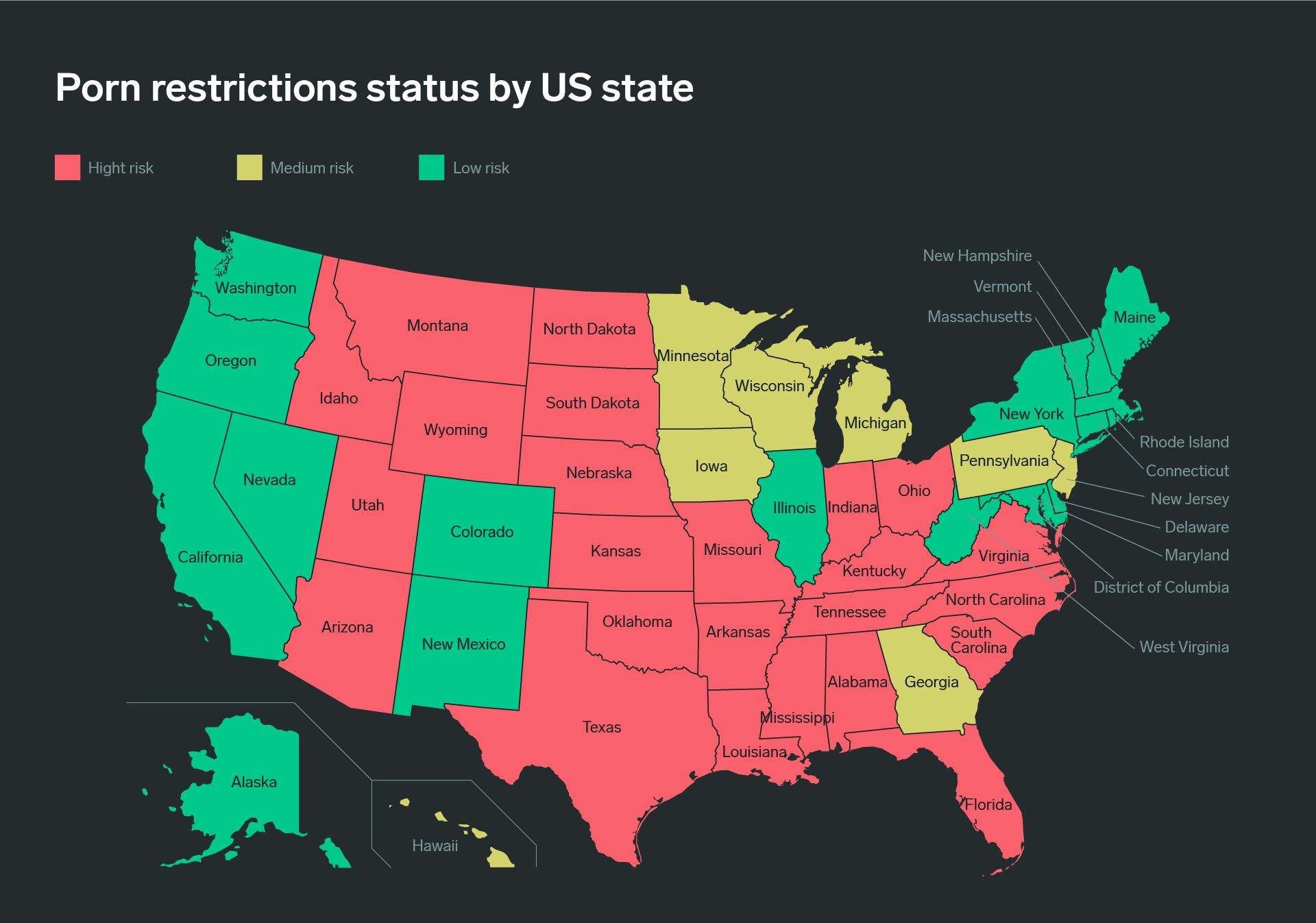
U.S. states with high porn restrictions
These states have high levels of restrictions on porn access due to enacted or about to be approved legislation on accessing porn online.
U.S. State | Status | Bill / effective date |
|---|---|---|
Alabama | HB 164 — Oct 1, 2024 | |
Arizona | Enacted (effective soon) | HB 2112 — Sep 25, 2025 |
Arkansas | SB 66 / Act 612 — Jul 31, 2023 | |
Florida | HB 3 — Jan 1, 2025 | |
Idaho | H 498 — Jul 1, 2024 | |
Indiana | SB 17 — Aug 16, 2024 | |
Kansas | SB 394 — Jul 1, 2024 | |
Kentucky | HB 278 — Jul 15, 2024 | |
Louisiana | Act 440 — Jan 1, 2023; HB 77 — Aug 1, 2023 | |
Mississippi | SB 2346 — Jul 1, 2023 | |
Missouri | Enacted (admin rule) | 15 CSR 60‑18 — May 7, 2025 |
Montana | SB 544 — Jan 1, 2024 | |
Nebraska | LB 1092 — Jul 2024 | |
North Carolina | HB 8 — Jan 1, 2024 | |
North Dakota | Enacted (effective soon) | HB 1561 — Aug 1, 2025; SB 2380 (age signal) — Aug 1, 2026 |
Ohio | Enacted (effective soon) | HB 96 — Sep 29, 2025 |
Oklahoma | SB 1959 — Nov 1, 2024 | |
South Carolina | HB 3424 — Jan 1, 2025 | |
South Dakota | HB 1053 — Jul 1, 2025 | |
Tennessee | SB 1792 — Jan 1, 2025 | |
Texas | Enacted / enforceable | HB 1181 — enforcement allowed per SCOTUS (Jun 27, 2025) |
Utah | SB 287 — May 3, 2023 | |
Virginia | SB 1515 — Jul 1, 2023 | |
Wyoming | HB 43 — Jul 1, 2025 |
U.S. states with moderate restrictions on porn
These states have or may enact moderate levels of porn restrictions and should be watched in the coming months or years.
U.S. state | Status | Bill / effective date |
|---|---|---|
Georgia | Related law (social media age checks) | SB 351 — not porn‑specific |
Hawaii | Introduced (2025) | HB 1198 / HB 1212 |
Iowa | Moving forward (2025) | SF 207/443; HF 864 — progressed |
Michigan | Introduced (2025) | SB 191; SB 284 / HB 4429 |
Minnesota | Introduced (2025) | SF 2105; HF 1434; HF 1875 |
New Jersey | Introduced (2025) | S4455; A4146 |
Pennsylvania | Introduced (2025) | SB 603; HB 1513 |
Wisconsin | Passed first chamber (2025) | AB 105 / SB 130 |
U.S. states with no restrictions on porn
- Alaska
- California
- Colorado
- Connecticut
- Delaware
- Illinois
- Maine
- Maryland
- Massachusetts
- Nevada
- New Hampshire
- New Mexico
- New York
- Oregon
- Rhode Island
- Vermont
- Washington
- West Virginia
Beyond porn: The broader privacy threat is here
These ID laws are only the beginning. Once the technology exists to verify your age for one type of content, it can be applied elsewhere: online gambling, cannabis sales, even access to encrypted chat apps.
The danger isn’t just that you’re tracked today, but that the record of your activity exists for years to come. In the U.S., where companies can legally sell user data, this information can resurface in insurance quotes, employment checks, or court cases.
Countries without porn restrictions
If you connect to servers in Switzerland, Netherlands, or Iceland, you bypass U.S. state-level filters entirely. These countries have strong privacy protections and no legal requirement for age verification on adult content, making them ideal VPN locations for privacy-conscious users.
Metadata: The overlooked privacy leak
Even if the content of your browsing is encrypted, your metadata — when you connect, how long you stay, and how much data you use — can reveal patterns about you.
Advanced networks like NymVPN use decentralized routing, cover traffic, and data mixing to disguise these patterns, sending decoy data alongside real traffic so that even your activity “shape” is obscured.
Are VPNs legal in the U.S.?
Yes — using a VPN in the United States is legal. However, if you use it to bypass a state’s age verification system, you could be violating that site’s terms of service. That’s a contractual issue, not a criminal one, but you should be aware of the distinction.
Why a decentralized VPN changes the Game
A decentralized VPN built on a mixnet encrypts and randomly shuffles your traffic across multiple independent servers. No single operator has the complete picture, making it extremely difficult for anyone — from ISPs to government agencies — to tie activity back to you. And because it’s open-source, anyone can verify how it works.
For setup tips and a list of features to look for, see our best porn VPN guide.
Notes & sources
Nym has compiled this data for your awareness from the Age Verification Providers Association (AVPA)’s U.S. tracker (24 states enacted as of May 20, 2025) and the Free Speech Coalition’s 2025 bill tracker (with new enactments added like Ohio HB 96 and rule changes like Missouri 15 CSR 60‑18). Texas enforcement status reflects the U.S. Supreme Court’s June 27, 2025 decision. Louisiana Act 440 and Utah SB 287 are the earliest modern U.S. AV laws. See AVPA Association, Free Speech Coalition, the Supreme Court.
Accessing porn privately in the US: FAQs
ISPs can log every domain you visit, even if the page content is encrypted. Without a VPN, they can link those visits directly to your account.
Cheap or overcrowded VPNs can cause buffering, but well-optimized decentralized networks keep speeds fast enough for HD and even 4K video.
Yes. Many VPNs work on smart TVs, streaming sticks, or routers so that every device in your home is protected at once.
No. Incognito mode only stops your browser from saving local history. Your ISP or government can still see your activity without a VPN.
About the authors
Rosa Fialho
WriterCasey Ford. PhD
Technical reviewerTable of contents
Keep Reading...

How to use a VPN to watch porn privately and bypass restrictions
Adult content doesn’t need to be restricted or require disclosing personal information. Here’s how to access it and protect yourself
The best VPN for porn
Choosing the best VPN tools to protect your privacy while accessing adult content

Nym is more than a VPN
The first app that protects you from AI surveillance thanks to a noise-generating mixnet
Who is tracking your internet activity, and why?
Your every move online is being tracked. Decentralized VPNs can better protect our privacy.