

Porn restrictions in the U.S. by state (2025)
Understand the laws in your state for accessing adult content, and what to do about it for your privacy


Share
As of 2025, more than a dozen U.S. states have introduced laws restricting access to adult websites like Pornhub and XVideos. These rules often require visitors to upload government-issued IDs for age verification, something most users don’t want to do.
When sites like Pornhub refuse to handle that data, they block entire states rather than risk privacy violations. If you’ve seen a message like “This site is unavailable in your region,” this is why.
This guide explains which states are affected, how these laws work, and how NymVPN helps you browse safely with state-level control.

States that have restricted Pornhub and other adult sites
It's not a free country when your freedom to information is different in 50 different locales. Here’s a current overview of U.S. states where adult content access is fully or partially restricted due to ID verification laws or content regulations.
Legend
- High: Enacted law or regulations for restricting adult content (active or takes effect in 2025)
- Medium: State Introduced laws which passed chamber but are not enacted
- Low: No statewide laws regarding restricting adult content
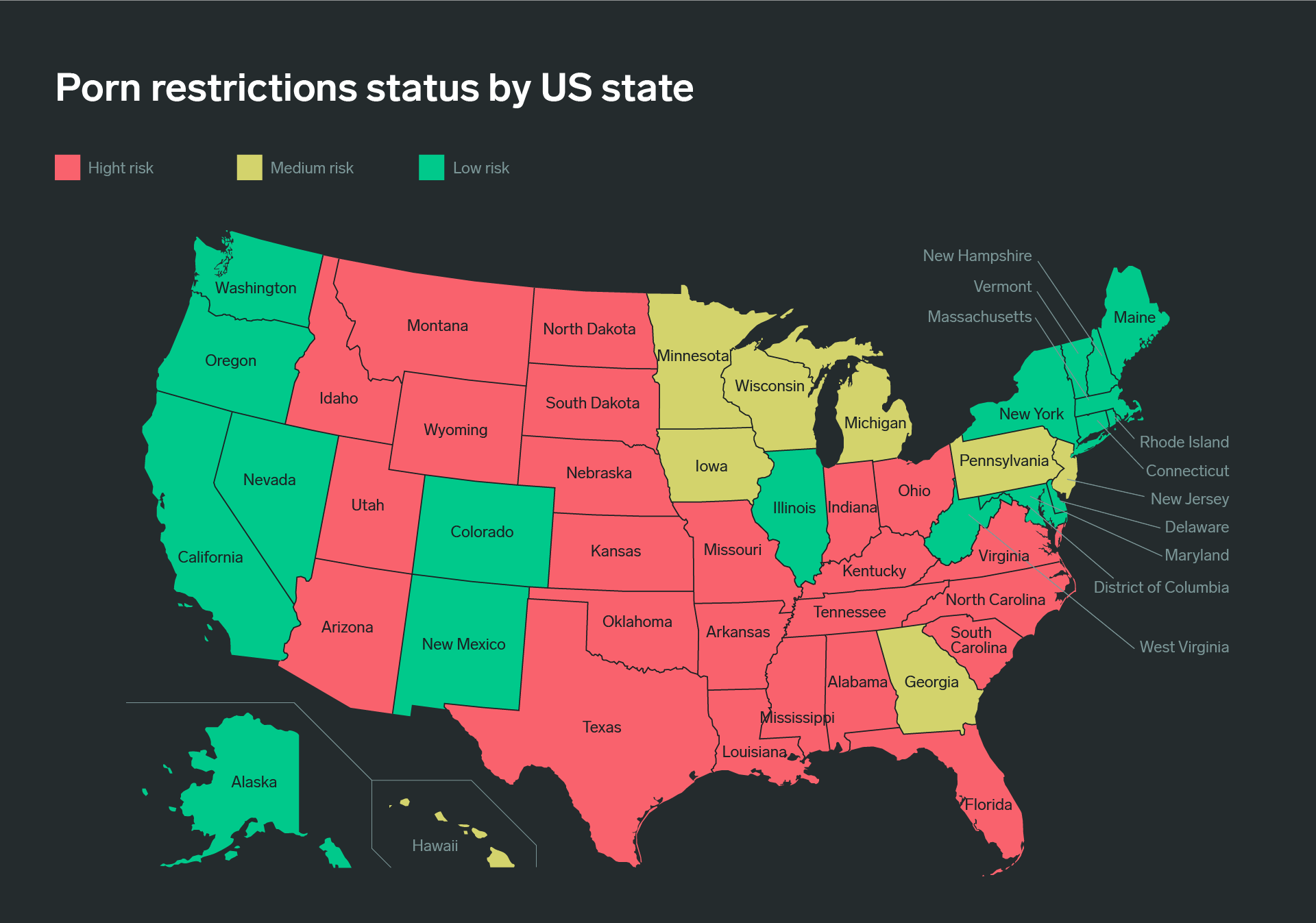
Porn restrictions status by US state
US State | Status | Bill / effective date | Risk |
|---|---|---|---|
Alabama | Enacted | HB 164 — Oct 1, 2024 | High |
Alaska | Low | ||
Arizona | Enacted (effective soon) | HB 2112 — Sep 25, 2025 | High |
Arkansas | Enacted | SB 66 / Act 612 — Jul 31, 2023 | High |
California | Low | ||
Colorado | Failed (2025 session) | SB 25‑201 — postponed | Low |
Connecticut | Low | ||
Delaware | Low | ||
Florida | Enacted | HB 3 — Jan 1, 2025 | High |
Georgia | Related law (social media age checks) | SB 351 — not porn‑specific | Medium |
Hawaii | Introduced (2025) | HB 1198 / HB 1212 | Medium |
Idaho | Enacted | H 498 — Jul 1, 2024 | High |
Illinois | Failed (2025 session) | HB 1103; SB 2082 | Low |
Indiana | Enacted | SB 17 — Aug 16, 2024 | High |
Iowa | Moving (2025) | SF 207/443; HF 864 — progressed | Medium |
Kansas | Enacted | SB 394 — Jul 1, 2024 | High |
Kentucky | Enacted | HB 278 — Jul 15, 2024 | High |
Louisiana | Enacted | Act 440 — Jan 1, 2023; HB 77 — Aug 1, 2023 | High |
Maine | Low | ||
Maryland | Failed (2025 session) | HB 1212 | Low |
Massachusetts | Low | ||
Michigan | Introduced (2025) | SB 191; SB 284 / HB 4429 | Medium |
Minnesota | Introduced (2025) | SF 2105; HF 1434; HF 1875 | Medium |
Mississippi | Enacted | SB 2346 — Jul 1, 2023 | High |
Missouri | Enacted (admin rule) | 15 CSR 60‑18 — May 7, 2025 | High |
Montana | Enacted | SB 544 — Jan 1, 2024 | High |
Nebraska | Enacted | LB 1092 — Jul 2024 | High |
Nevada | Failed (2025 session) | AB 294 | Low |
New Hampshire | Low | ||
New Jersey | Introduced (2025) | S4455; A4146 | Medium |
New Mexico | Failed (2025 session) | HB 44 | Low |
New York | Failed (2025 session) | S3591 / A3946 | Low |
North Carolina | Enacted | HB 8 — Jan 1, 2024 | High |
North Dakota | Enacted (effective soon) | HB 1561 — Aug 1, 2025; SB 2380 (age signal) — Aug 1, 2026 | High |
Ohio | Enacted (effective soon) | HB 96 — Sep 29, 2025 | High |
Oklahoma | Enacted | SB 1959 — Nov 1, 2024 | High |
Oregon | Failed (2025 session) | HB 2032 | Low |
Pennsylvania | Introduced (2025) | SB 603; HB 1513 | Medium |
Rhode Island | Low | ||
South Carolina | Enacted | HB 3424 — Jan 1, 2025 | High |
South Dakota | Enacted | HB 1053 — Jul 1, 2025 | High |
Tennessee | Enacted | SB 1792 — Jan 1, 2025 | High |
Texas | Enacted / enforceable | HB 1181 — enforcement allowed per SCOTUS (Jun 27, 2025) | High |
Utah | Enacted | SB 287 — May 3, 2023 | High |
Vermont | Low | ||
Virginia | Enacted | SB 1515 — Jul 1, 2023 | High |
Washington | Low | ||
West Virginia | Failed (2025 session) | SB 293; HB 2689 | Low |
Wisconsin | Passed first chamber (2025) | AB 105 / SB 130 | Medium |
Wyoming | Enacted | HB 43 — Jul 1, 2025 | High |
Why these laws exist
Supporters of these laws claim they protect minors, but they come with major privacy tradeoffs. Requiring users to upload IDs or face scans introduces long-term data risks, since these verification databases can be hacked, sold, or subpoenaed.
In practice, these policies pressure adults to surrender personal information in exchange for basic internet access, and that’s a dangerous precedent.
NymVPN’s state-level routing: A smarter way to bypass censorship
Most VPNs only let you select servers by city or country, which works for streaming or bypassing geo-blocks but not for state-level censorship.
For example, connecting through Dallas or Houston on a typical VPN still places you inside Florida, where adult content is blocked statewide. Even if you switch cities, you can still be denied access.
NymVPN fixes this with state-level routing. It lets you choose connections in privacy-friendly states like California or New York, ensuring you never tunnel into a restricted region by accident.
This level of precision matters because it:
- Avoids accidental routing through blocked states
- Increases success rates when accessing adult or restricted content
- Reduces content errors caused by mismatched IP data
- Blends your traffic into a decentralized mixnet for stronger anonymity
By letting you select your state, not just your city, NymVPN gives you true control over your digital location and privacy.

How to regain access privately
If you live in or travel through a restricted state, here’s how to restore access safely:
- Download NymVPN.
- Create your anonymous account — no ID or email required.
- Select an entry server in a non-restricted state like New York or Illinois
- Use the Fast mode for HD streaming with decentralized protections.
- Browse normally — Nym keeps your identity, location, and activity private.
Why state-level privacy matters
State laws shouldn’t decide what you can or can’t view online. Yet digital censorship is being legislated by geography — and the same infrastructure used to block adult sites could one day be used to restrict health, political, or LGBTQ+ content.
Choosing a VPN that understands state boundaries keeps your digital rights intact. With NymVPN’s decentralized design, there are no central servers or logs, and no single authority capable of linking your identity to your browsing.
Build a robust privacy stack
Using NymVPN is the most powerful first step toward online privacy, but lasting protection comes from combining tools that cover every layer of your digital life.
Together, they create a secure ecosystem where your identity, communications, and payments remain truly yours.
1. Decentralized VPN (NymVPN)
Your gateway to an uncensored internet. NymVPN hides your IP address, encrypts traffic, and prevents metadata leaks through a decentralized mixnet. It keeps your location private even against state-level restrictions and ISP monitoring.
2. Private Messaging
Apps like Session let you chat without phone numbers or server logs. They route messages through an onion-routed network, protecting metadata that even most encrypted messengers still reveal.
3. Privacy-respecting search engines
Switch from surveillance-based search engines to private alternatives that don’t log your queries or clicks. Combine these with NymVPN for complete search anonymity. → See recommendations in Most Private Search Engines
4. Anonymous payments
Cryptocurrencies like Monero and Zcash offer privacy-preserving ways to pay for digital services or subscriptions without linking transactions to your identity. Using private crypto ensures your financial data stays separate from your browsing activity.
5. Private browsers
Use privacy-first browsers that automatically block trackers and fingerprinting scripts. Add lightweight extensions for password protection, script control, and cookie isolation to reduce your digital exhaust and keep everyday browsing private.
Porn restrictions by US state: FAQs
Yes. Using a VPN for privacy is legal in every U.S. state. These laws regulate site operators, not individuals seeking privacy.
NymVPN is decentralized and allows state-level selection, while most VPNs route by city or country. This avoids accidental connections to blocked regions.
Traditional VPNs can be flagged or throttled, but NymVPN’s mixnet traffic is indistinguishable from normal encrypted traffic, making detection nearly impossible.
No. NymVPN uses a zero-knowledge design that prevents log creation entirely. Your browsing history, connection timestamps, and IP data remain private.
Notes & sources: Nym has compiled this data for your awareness from the Age Verification Providers Association (AVPA)’s U.S. tracker (24 states enacted as of May 20, 2025) and the Free Speech Coalition’s 2025 bill tracker (with new enactments added like Ohio HB 96 and rule changes like Missouri 15 CSR 60‑18). Texas enforcement status reflects the U.S. Supreme Court’s June 27, 2025 decision. Louisiana Act 440 and Utah SB 287 are the earliest modern U.S. AV laws. See AVPA Association, Free Speech Coalition, the Supreme Court.
About the authors
Rosa Fialho
WriterCasey Ford. PhD
Technical reviewerTable of contents
Keep Reading...
The best VPN for porn
Choosing the best VPN tools to protect your privacy while accessing adult content
How to use a VPN to watch porn privately and bypass restrictions
Adult content doesn’t need to be restricted or require disclosing personal information. Here’s how to access it and protect yourself

Nym is more than a VPN
The first app that protects you from AI surveillance thanks to a noise-generating mixnet
Nym’s zero-knowledge network: No logging promises needed
Turning a VPN no log’s policy into a network design and guarantee